
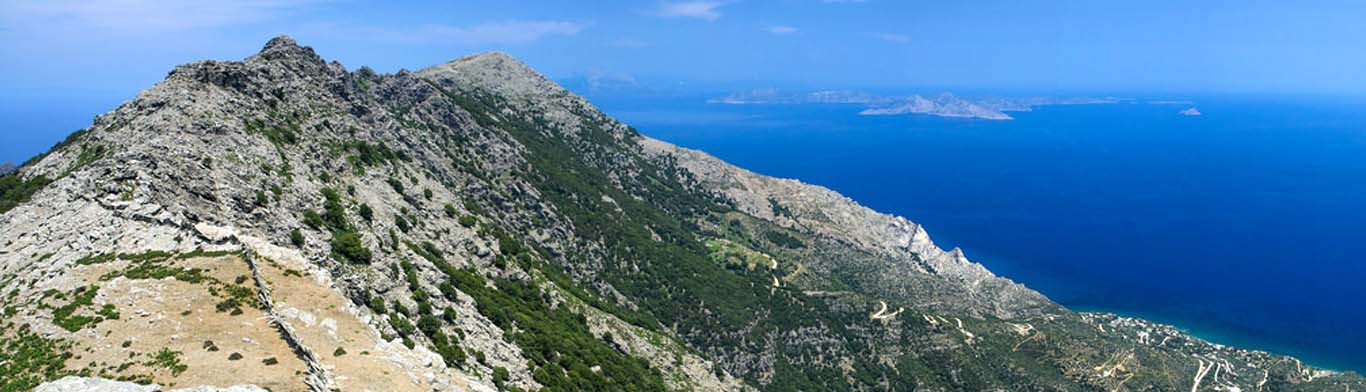
Ikaria is not a destination that reveals itself at first sight. It has a strong character, dramatic landscapes, and a rhythm of life that invites you to slow down and follow it. If you are planning your visit, the information below will help you understand the island and move around with ease.
Population & human scale
Ikaria has around 8,800 permanent residents, spread across villages and small settlements throughout the island.
During the summer months, the population increases noticeably, yet Ikaria never loses its authentic, local feel. Life moves at a calm pace, and distances are experienced without stress.
Size & landscape: a large, mountainous island
With an area of approximately 255 square kilometres, Ikaria is among the larger islands of the Aegean Sea. Its most defining feature is its mountainous terrain.
The Atheras mountain range, with peaks rising above 1,000 metres, runs through the island and strongly influences:
- the road network
- travel times
- the distinct character of the north and south sides of Ikaria
Ikaria is not an island of straight lines, but of winding, scenic routes.
Agios Kirykos: the capital and main point of reference
Agios Kirykos is the capital of Ikaria and, for many visitors, the most practical base on the island.
This is where daily life is more concentrated, with public services, shops, cafés, and one of the island’s two main ports.
For this reason:
- it attracts slightly more visitors,
- it is often considered the “central” point of Ikaria,
- it works especially well for first-time visitors.
It may not be more touristy, but it is certainly more convenient.
Roads & distances
The main roads are paved, but the island’s terrain brings plenty of curves and changes in elevation.
In Ikaria, travel time matters more than kilometres.
Indicatively:
- Agios Kirykos → Evdilos: about 1 hour by car
- Evdilos → Armenistis: 20–25 minutes
- Airport → Agios Kirykos: 15–20 minutes
Driving here is part of the experience.
Getting to Ikaria
You can reach Ikaria:
- By ferry, via the ports of Agios Kirykos and Evdilos,
- By plane, through the island’s airport, located close to Agios Kirykos.
During summer, connections are more frequent, making access easier.
A short trip to the Fournous Islands
One of Ikaria’s lesser-known advantages is its very close proximity to the Fournous Korseon.
The Fournous Islands are connected by ferry and make an ideal option for:
- a day trip
- a quiet 1–2 night stay
- experiencing an even smaller and more traditional island setting
For many visitors, Ikaria becomes the perfect base to explore this hidden corner of the Aegean.
Getting around the island: our recommendation
Renting a car is, in our view, the easiest and safest way to get around Ikaria.
Due to the island’s terrain, distances, and limited public transport schedules, a car offers:
- greater safety
- flexibility in your daily plans
- easy access to beaches and villages beyond the main areas
Buses and taxis do exist, but they may not fully meet your needs if you wish to explore the island freely.
A few more things that make Ikaria special
- Ikaria is internationally known as a Blue Zone, with remarkably high life expectancy.
- The island has never developed as a mass tourism destination.
- Local festivals are part of everyday life, not staged events.
- Time flows differently here — and you feel it from the very first days.
In closing
Ikaria is an island large in size yet gentle in rhythm, with Agios Kirykos as its capital, easy access points, and a truly unique character.
It suits both travellers who wish to explore deeply and those who simply want to slow down — perhaps even crossing over to the Fournous Islands for a short escape.
Ready to experience Ikaria for yourself? Browse our rooms or get in touch via our contact page to plan your stay. For more background on the island, see the Wikipedia entry on Ikaria.