
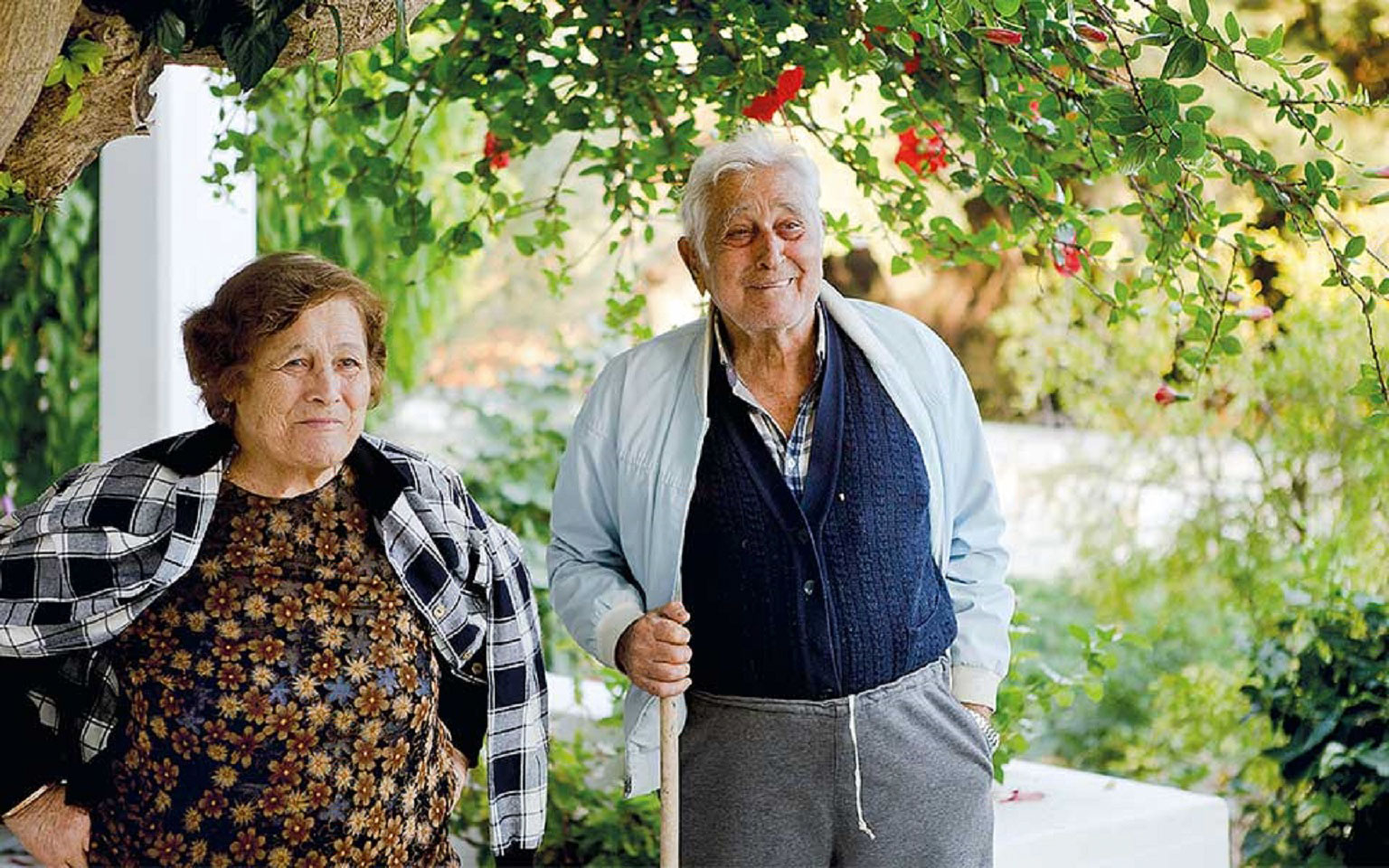
There are five places on Earth where science has confirmed that people live measurably longer and healthier lives than the rest of the world. They are called Blue Zones. One of these five places lies in the northeastern Aegean Sea, just 30 nautical miles from the Turkish coast: the Greek island of Ikaria. This is the story of Ikaria Blue Zone longevity — and what it can teach the rest of us.
The phrase that follows this island in every language — “the island where people forget to die” — is not a tourist slogan. It is the title of a 2012 New York Times article written by Dan Buettner, the researcher who mapped the Blue Zones for National Geographic and the U.S. National Institute on Aging.
What Are Blue Zones and How Was Ikaria Discovered?
The term “Blue Zone” was born in the late 1990s when Belgian demographer Michel Poulain and Italian researcher Gianni Pes identified an unusual concentration of centenarians in Sardinia. They drew a circle on the map in blue ink — hence the name. Buettner continued the research worldwide, and to date five Blue Zones have been scientifically verified: Ikaria (Greece), Okinawa (Japan), Sardinia (Italy), the Nicoya Peninsula (Costa Rica), and Loma Linda, California.
Ikaria earned its place on the list after demographers from the University of Athens School of Medicine, led by Michel Poulain, cross-referenced birth records against baptism certificates and military documents to verify residents’ ages. The conclusion was clear: Ikarians reach the age of 90 at two and a half times the rate that Americans do.
The Numbers That Made the World Take Notice
The so-called Ikaria Study, conducted by the University of Athens School of Medicine and published in the journal Cardiology Research and Practice, followed 1,330 residents — 631 men and 699 women — of whom 187 were over the age of 80. It examined diet, lifestyle, mental health, and physical condition.
The findings were striking. Thirteen percent of Ikaria’s population belongs to the elderly age group — compared to roughly 5% of over-80s in the Greek national average. Dementia rates are dramatically lower than in the West: according to Buettner, among all residents over age 70 on the island, only three mild cases of dementia were found. By contrast, in the United States, roughly one in two people who reach 85 shows symptoms of dementia. CNN, reporting on the research, noted that Alzheimer’s rates in Ikaria are approximately one-fifth of those in America. On average, Ikarians live 7 to 10 years longer than Americans.
Why? The Nine Secrets of Longevity
Buettner distilled the shared characteristics of Blue Zone communities into nine principles he called the “Power 9.” In Ikaria, they play out as follows.
1. Natural movement — no gym required. Ikaria is mountainous. Every day, residents walk uphill, tend gardens, and carry things. As Buettner put it: “These people are living in villages and walking up and down hills every day. They’re nudged into movement every 20 minutes or so.” It’s not a program — it’s simply life.
2. The afternoon nap. The siesta in Ikaria is not a luxury — it is a generational habit. The Ikaria Study linked the midday nap to reduced risk of heart disease, as it lowers inflammation and blood pressure. Residents often stay up late at night and sleep in, fitting rest into the rhythm of the day rather than fighting against it.
3. The diet. Ikarian food is what Buettner has called an “extreme version” of the Mediterranean diet. More than 50% of daily calories come from fat — almost entirely olive oil. Bread, pasta, and processed foods are rare. Instead: legumes (chickpeas, lentils, black-eyed peas), seasonal vegetables, foraged wild greens, local goat’s milk and cheese, fish 6 to 8 times a month, and meat only occasionally.
4. The herbs of Ikaria. Over 150 varieties of wild greens grow on the island, many with antioxidant levels higher than red wine. The daily herbal tea ritual — sage, rosemary, oregano, chamomile, mint, artemisia — is both social and medicinal. Many of these herbs act as mild diuretics, reducing blood pressure and inflammation. Local thyme honey, rich in antioxidants and antimicrobial compounds, is considered by locals to be one of nature’s medicines.
5. Wine, slowly and with company. Local red wine — often homemade — is consumed in the evening, slowly, with friends. It is not the wine alone that matters; it is the context in which it is drunk.
6. Greek coffee. The Ikaria Study found that regular consumption of Greek coffee was associated with improved endothelial function — healthier blood vessels. Professor Stefanadis, one of the study’s lead authors, cited it explicitly as a longevity factor.
7. No stress — and no clocks. Ikaria runs on its own time. The island has become known informally as “the island without clocks.” Residents sleep late, wake late, and are never in a hurry. Chronic stress is a proven accelerator of cellular aging; in Ikaria, the sense of urgency simply does not exist.
8. Social life. A remarkable 86.7% of men and 76.7% of women over the age of 80 participate in social activities — visits, village festivals, coffee at the café. Social isolation is a documented cause of premature death. In Ikaria, it is almost unknown.
9. Purpose and belonging. Elderly Ikarians remain active members of their communities — they teach, work, celebrate, and participate. Retirement in the sense of social withdrawal does not really exist here.
What Science Says About Genetics
A detail often overlooked: according to the Danish Twin Study, only about 20% of how long a person lives is determined by their genes. The remaining 80% depends on lifestyle and environment. This means the secrets of Ikaria do not belong exclusively to Ikarians — they belong to anyone who chooses to adopt them.
From the Pages of National Geographic to Netflix
Buettner’s 2012 New York Times feature on Ikaria went viral worldwide. In August 2023, Netflix released the documentary “Live to 100: Secrets of the Blue Zones,” hosted by Buettner, which won three Daytime Emmy Awards. Ikaria was one of the central chapters. Interest in the island was renewed globally.
Experience Ikaria Blue Zone Longevity Yourself
Ikaria’s longevity is not a museum exhibit — it is the daily life of the island. The moment you arrive, you feel it: time moves differently, food is simple and good, people talk without rushing. Nobody asks what you do for a living. They ask how you are.
At Kastro Hotel in Agios Kirykos, you are right in the middle of this experience. The market, the harbor, the cafés around the main square — all within walking distance. If you want to see for yourself what the world is looking for when it asks how to live longer and better, this is the place to start.
If Ikaria’s longevity culture has you curious to experience it firsthand, browse our rooms or read more about Kastro Hotel. For the original research, see the Blue Zones entry on Wikipedia.